
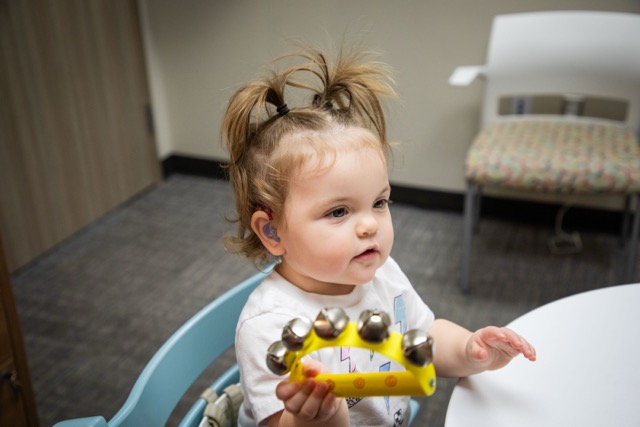
Hear Their Stories: Isla’s Hearing Loss Journey
19-month-old Isla is bubbly little girl who loves exploring, playing, reading, and dancing along to Elmo. Hear her story and hearing loss journey.
Home / Children / Eyes Open, Ears On / Hearing Technology
If your child has an accurate diagnosis of hearing loss, it is likely that your audiologist will recommend hearing technology. Hearing technology comes in a variety of forms and is recommended by considering the type of hearing loss, the amount of hearing loss, and the age of your child. It is important to fit technology as early as possible for the best listening and spoken language outcomes.
A cochlear implant system contains two components, 1) an external sound processor, and 2) a cochlear implant. The external sound processor is typically worn on the ear or head. It contains microphones that detect sound and deliver it to a computer processor. The processed sound is then delivered to an antenna that transmits the processed signal to the cochlear implant. The cochlear implant contains an antenna that captures the transmitted signal and delivers it to another computer processor that converts the signal to electrical pulses. The electrical pulses are delivered to a small wire that is implanted in the cochlea (i.e., the inner ear) to stimulate the hearing nerve.
Cochlear implants are often recommended for children who have severe to profound hearing loss (and also for some children with auditory neuropathy spectrum disorder) and who do not hear well enough with hearing aids to make age-appropriate progress in their listening and spoken language skills. For most children with severe to profound hearing loss, the hearing nerve functions well, but the inner ear does not. The cochlear implant bypasses the dysfunctional inner ear and sends the auditory signal directly to the hearing nerve and then onto the brain.
There are several factors that go into how well a child will hear with a cochlear implant, including but not limited to:
Cochlear implants may be recommended for one or both ears, depending on the type and level of hearing loss. A team of persons including the child’s family, audiologist, Listening and Spoken Language Specialist, ear surgeon, etc. will determine whether a cochlear implant is the best option to support a child’s well-being and development.
At Hearts for Hearing, we have seen many children thrive with hearing technology. These devices allow our patients to communicate, learn, and engage with their family and friends. If you have questions about hearing technology and are interested in learning more about hearing aids for your child, we encourage you to schedule an appointment with our team. We are committed to supporting your child’s hearing health journey and look forward to partnering with you to achieve your child’s optimal hearing health so they can listen for a lifetime.
19-month-old Isla is bubbly little girl who loves exploring, playing, reading, and dancing along to Elmo. Hear her story and hearing loss journey.
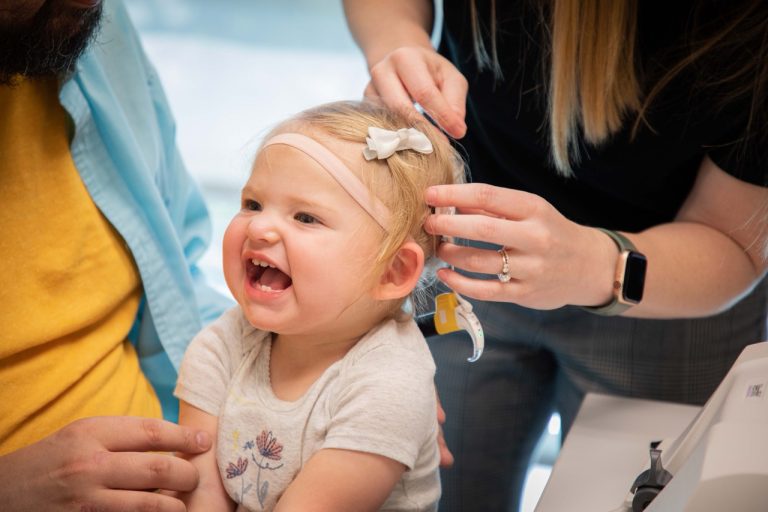
Mom describes the pregnancy and delivery as nothing out of the ordinary. Looking back, she remembers being comforted by the fact that a nurse mentioned how well Zoe slept that first night – even though other babies were crying all around her.
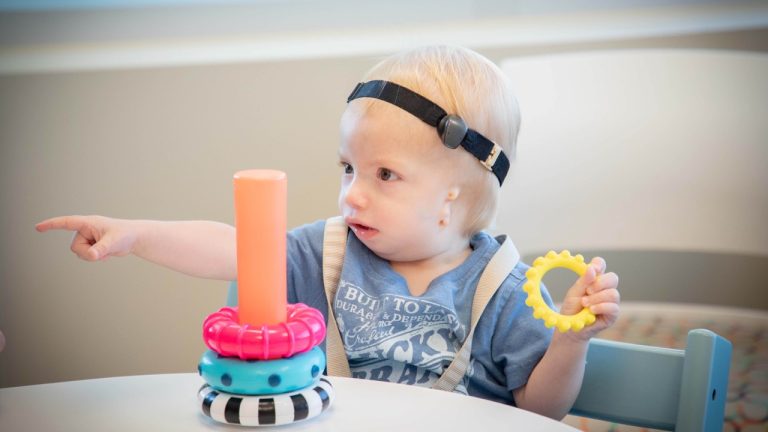
When Carter was born in early summer 2022, Mom and Dad say they were “blind-sided” when he was born with bilateral microtia. This is a condition defined as underdevelopment of the ear, which means the ear is either too small or not shaped as it should be, or both. Carter